2020年john locke論文競賽初級散文First Prize全文

2020年john locke論文學術活動初級散文First Prize全文公布,今年的學術活動即將開始,回顧過往的論文對于沖刺備戰是有幫助的,一起跟著小編來看看初級散文一等獎的全文是什么內容。
Who should own your data? The companies with which you agree to share your data, everybody, just you, or nobody?
Jason Hausenloy, United World College of South East Asia (East Campus), Singapore
Winner of the 2020?Junior?Prize??| 7.5?min read?
Today, we produce unfathomable amounts of data, leading the OECD to call data?a “key pillar of 21st-century growth.”[1] Legislators, politicians and the popular press have increasingly called for ownership of data.[2]
Ownership is generally defined as “full and complete control with recognised legal rights,” with legal discretion for the rightsholder to exploit, change, destroy, possess, exclude others from and transfer their property.[3] An ownership right for personal data does not currently exist in the legal statutes of any industrialised country.[4] Property laws intentionally exclude personal data from subject matter definitions and newly introduced regulatory frameworks do not specify data ownership.[5] [6]
In 1893, Sir William Blackstone noted the human fascination with ownership, saying we desire “sole and despotic dominion … in total exclusion of rights of other individuals in the universe.”[7] In this case, that fascination detracts from the problems and solutions surrounding personal data today. An ownership right should not be created for data. To illustrate this, I shall explore the implications of assigning a data ownership right to corporations, everybody, individuals and then discuss why data should not be owned at all.
Corporations
Legally, data generated by corporations have limited protection under trade-secret and other commercial laws.[8] However, corporations have gained de facto control of our data without our explicit consent through cleverly-crafted user interfaces, consumer nonchalance and labyrinthine policies hidden within fine print. The Norwegian Consumer Council exposed?“dark patterns” - default settings, nudging, the creation of an illusion of choice - used by tech companies to discourage consumers from exercising their privacy rights.[9] Furthermore, surveys show, in light of recent data privacy scandals, individuals say they are increasingly distrustful in corporations to adequately protect their privacy.[10] Nevertheless, in practice, individuals demonstrate little regard for their personal data, a dichotomy referred to as the “privacy paradox.”[11] Empirical research?has shown the majority of users lack the time and expertise to understand fine print.[12] Consumers readily grant consent to handover data in exchange for convenience or access to services.[13]
By examining the current state of the data economy, under the de facto control of corporations, we can anticipate the potential implications of corporate data ownership.
Dominant players of the data economy boast revenues that eclipse national GDPs and user populations that exceed continents.[14] They aspire to automate, predict and influence individual behaviour, often without their knowledge. In this way, they have provided immense consumer benefit. Few can imagine living without Google search, WhatsApp messaging, or Amazon delivery. However, this monopoly on data has equipped tech giants with enormous power, which has resulted in a stagnant data economy and monopolistic markets.
Data exhibits unique properties from other economic goods. It is intangible, non-exhaustible, easily duplicated and can be simultaneously used by multiple parties in a non-rivalrous manner.[15] Through analysis of existing datasets, new findings and knowledge can be extracted. At the onset, these attributes imply data should circulate freely to maximise the scope of potentially beneficial applications. Unfortunately, this is not happening with each company protects its own vaults of user data with limited transactions.[16] Untraded, data suffers “the tragedy of the anticommons” in which a non-rivalrous good is wastefully underused at the detriment of consumers and society.[17]
Digital monopolies have a data-supported “God’s eye” view of their own market, with unparalleled insight into nearly every aspect of consumer life. They buy or undercut smaller, potential competitors. Facebook’s purchase of WhatsApp or Amazon’s undercutting of third-party sellers are two of many examples.[18] They are unlikely to be blindsided by small start-ups or unexpected technological shifts and, with undue pricing advantages, can consolidate or expand their market shares without necessarily innovating.[19] With legally-recognised ownership, corporations further lack the incentive to reduce current inequalities in wealth distribution from the expanding data economy, protect consumers or actuate a sustainable data economy to facilitate societal progression.[20]
To summarise, corporations have shrewdly gained our permission and can easily do so again. The data economy desperately requires data standardisation and portability to level the playing field and realise the immense socioeconomic potential of today’s abundance of data. Corporate ownership of data removes control and protections from consumers and regulators and will worsen today’s problems. So why not entrust data ownership to “everybody” who, by definition, should act for the common good?
Everybody
Having everybody owning everyone’s data implies all can legally access, manipulate and mine everybody else’s identifiable data. In this scenario researchers could analyse unbiased population datasets, start-ups could access the same raw data as giant corporations and AI algorithms could train on continuously acquired, diverse datasets. However, privacy would be non-existent and current innovation stymied.
There are obvious privacy issues if identifiable personal data are accessible by all. Openly-available data, in the wrong hands, can be manipulated for mass surveillance, identity theft, blackmail or even social engineering. To address this, regulators have proposed anonymisation as a potential solution. Data protection laws consider anonymised data as “non-personal,” stripping it of many privacy protections.[21] In theory, properly anonymised data, by definition, would be impossible to link to an identifiable person - however, current anonymisation techniques are ineffective. There are countless examples of supposedly anonymised databases being re-identified.[22] [23] [24] To promote transparency, the Australian Government released de-identified health records of 10% of Australians, which the University of Melbourne subsequently re-identified?with openly available public information.[25] The Guardian secured the browsing history of three million Germans from a so-called “data broker” and individually identified?users and exposed deeply sensitive information such as sexual preference or medications.[26] Furthermore, Rocher, Hendrickx and Montjoye, published a statistical model?that can, with just 15 demographic attributes, uniquely identify 99.98% of Massachusetts residents. They challenged “the technical and legal adequacy of the de-identification release-and-forget model.”[27]
Even personal data handled by governments and corporations are anonymous only in name. The extensive detail of these datasets pale, however, in comparison with the plethora of data collected by today’s digital giants. If released, anonymised or otherwise, individual privacy would cease to exist.
Furthermore, data collectors would rightfully object to competitors using data produced from their investment or grants. Data’s mandatory release jeopardises business models made possible through data collection and removes incentive for continued innovation. A report?released by MIT and Oracle argues that, for corporations, user data is an indispensable capital good and competitive advantage.[28] Forced, non-discriminating distribution of capital goods undermines key principles of the free market.
In summary, public ownership of data, anonymous or otherwise, results in significant degradation in privacy and innovation. So how about an option championed by privacy campaigners, politicians and media alike - individual ownership?
Individuals
Proponents for individual ownership argue that this offers the ultimate protection of privacy and allows fair financial compensation for personal data.[29]?You own your house, you retain the full legal rights to sell it, to rent it and to exclude others from entering. It is understandably appealing.
Unfortunately, these arguments are flawed. Individual ownership and accompanying data markets, are impractical, harmful for consumers and, counterintuitively, degrade and damage privacy.
Firstly, information today rarely concerns a single individual. We take group photos, travel with other people and even our genetic code reveals information about our parents. Assuming the predicament of co-ownership can be solved, a data market is impractical.
Given its intangibility, putting a price on data is extremely challenging. Small businesses cannot afford to pay for people’s data, making it difficult to complete and comply and the compensation paid by large companies will be negligible. For example, Facebook’s worldwide?revenue per user?is
$6.42 - only a fraction of that would be paid as “data dividends.”[30] Furthermore, consumers would have to continuously manage data contracts with each service provider, which could result in consumer decision fatigue.[31] Corporations may then take advantage of this by appending clauses demanding exclusive, royalty-free, ownership rights to data as a prerequisite to the use of services. A single bad decision to sell or sign away personal data could be irreversible. Corporations would have little incentive to promote data portability or competition; users will continue to be walled into ecosystems of data monopolies.
In addition, individual ownership may damage the common good. It opens the door to unwanted nuisance or even civil disruption to governance and law enforcement. For example, during the globally-enforced COVID-19 lockdowns, individuals could object to their location being tracked and contest police enforcement strategies, such as CCTV cameras?or drones.[32] Socially beneficial activities, like medical informational studies or AI research, may only have greatly diminished or biased data sets.
Lastly, human rights such as privacy and data protection, under current legislation, are inalienable rights.[33] Under individual ownership, those rights are degraded to alienable economic goods,[34] and should not be open to surrender or sale.[35]
In summary, individual data ownership fails at many levels. Privacy International, a leading privacy advocacy organisation, concluded that?individual ownership fails to protect consumers, combat data monopolies and is fundamentally incompatible with data.[36] Therefore, current legislation, human rights organisations and academia have largely ignored or argued against ownership of data.[37] Why?
Nobody
The problems and challenges of data ownership highlighted in the prior sections, can be summarised as follows; market concentration of tech companies, wasteful underuse of data, privacy concerns and increasing consumer distrust but subsequent inaction. Many associate legislative inaction to assign data ownership as the root cause of these problems, blaming the control vacuum for inviting greedy corporations and autocratic governments to seize power. There is an important distinction between the non-assignment of ownership and inaction, however. Demands for radical change are warranted, but should take the form as a continuation of current progress. Continued discussion of the precarious implementation of data ownership side-tracks political, academic and public focus to address these underlying problems.
Professor Lothar Determann argues there is no legal principle for data ownership, writing in the Hastings Law Journal, that “property laws may protect physical embodiments of information...but such protection does not extend to the informational content.”[38] He further contends that incentivising data collection, the rationale offered by lawmakers for creating ownership rights in data, is invalid, as collection will continue to grow exponentially.[39]
Legislative progress has been made without data ownership. The EU has incentivised data access and EU-wide data markets, even making its own publicly held datasets accessible for reuse, while simultaneously balancing individual concerns, introducing the widely-adopted General Data Protection Regulation (GDPR).[40] It grants specific rights to individuals over generated and inferred personal data such as; erasure, rectification, data portability and more.[41] Furthermore, it sets out privacy principles?such as data minimisation, fairness and purpose specification, which shift the burden from individuals to corporations.[42]
There are many examples of revolutionary data-driven advances in many sectors of society[43] including decentralised systems and various business models (the “sharing economy,” for example).[44] Distributed Data Network architectures for medical research are trialling in Canada, the EU and Japan.[45] Federated Learning?enables Machine Learning training on decentralised data, like that saved on individual devices - and is already being implemented.[46] More recently, unfettered access to personal data has been critical in the fight against today’s COVID-19 pandemic.
OpenSAFELY, an analytics platform for sharing the data of 17 million NHS patients,[47] has enabled the discovery of new risk factors and novel treatments for COVID-19.[48] Apple and Google have partnered to develop a Bluetooth contact-tracing platform for COVID-19 that addresses user privacy and security concerns. Under the rigidity of data ownership, these efforts would not have been possible.
Today, policy makers must strike a balance between individual rights and extracting societal benefits of data. It is the subject of age-old philosophical debate; whether to prioritise a categorical imperative of privacy at the expense of utilitarian societal progress. Assigning data ownership to a single party means choosing a side, one side will inevitably lose out - sacrificing progress or privacy. Thankfully, reality does not reflect this simplistic trade-off. Ergo, legislators must continue to push for a sector-specific rights-based regulatory framework to complement existing efforts and forgo the need to legislate through assigning data ownership. Therefore, I believe, data should remain as is, res nullius - “property of no one.”
Author's Note:
Unless specified otherwise, I will interpret “your data” to mean personal data as it is commonly differentiated as such in regulation and discussion on data protection. Personal data is a category of data defined, according to the General Data Protection Regulation, to be “any information which are related to an identified or identifiable natural person.”
Footnotes
1 OECD (2015), Data-Driven Innovation: Big Data for Growth and Well-Being, OECD Publishing, Paris,?https://doi.org/10.1787/9789264229358-en.
2 E.g. The Economist. 2019. “We Need to Own Our Data as a Human Right—and Be Compensated for It.” The Economist. January?21, 2019. https://www.economist.com; “Digital Privacy Rights Require Data Ownership.” 2018. Financial Times. March 21, 2018.?https://www.ft.com/; Ritter & Mayer, Regulating Data as Property: A New Construct for Moving Forward, 16 Duke Law & Technology Review 220-277 (2018)
3 “Definition of OWNER ? Law Dictionary ? TheLaw.Com.” The Law Dictionary, July 12, 2014.?https://dictionary.thelaw.com/owner/.
4 Determann, Lothar. 2018. “No One Owns Data.” SSRN Electronic Journal. 24-25?https://doi.org/10.2139/ssrn.3123957;?Max Planck Institute for Innovation and Competition, “Arguments Against ‘Data Ownership’ - Max Planck Institute for Innovation and Competition.” 1-2. Max Planck Institute for Innovation and Competition. 2020. (“However a data ownership right does not currently exist either at EU or Member State level, or in any other industrialised country”)
5 See General Data Protection Regulation, para. 63 “(General Data Protection Regulation)” 2016.?https://eur-?lex.europa.eu/
6 Determann, See Supra note 3, at 24-26
7 Blackstone, Sir William. 1893 “Of Property, in General” in George Sharswood (ed) Sir William Blackstone, Commentaries on the Laws of England in Four Books (J.B. Lippincott Co, Philadelphia, 1893) Vol 1, Bk 2, Ch 1 8 Determann, See Supra note 4. 14-17
9 “Report: Deceived by Design?: Forbrukerr?det.” 2018. Forbrukerradet.No. 2018. 6, 13-19, 31. https://www.forbrukerradet.no
10 Shipman, Frank M. and Catherine C. Marshall. “Ownership, Privacy and Control in the Wake of Cambridge Analytica | Proceedings of the 2020 CHI Conference on Human Factors in Computing Systems.” 2020.?https://dl.acm.org/doi/abs/10.1145/3313831.3376662.
11 Barth, Susanne and Menno D.T. de Jong. “The Privacy Paradox – Investigating Discrepancies between Expressed Privacy Concerns and Actual Online Behavior – A Systematic Literature Review.” Telematics and Informatics 34, no. 7 (November 2017): 1038–58.?https://doi.org/10.1016/j.tele.2017.04.013.
12 “Does Anyone Read the Fine Print? Consumer Attention to Standard-Form Contracts on JSTOR.” 2014. 9-13, 31-32. Jstor.Org. 2014.?https://www.jstor.org/;
13 Whitley et al. 2018. “Report on a Study of How Consumers Currently Consent to Share Their Financial Data with a Third Party.” https://www.fs-cp.org.uk/
14 See Winck, Ben. 2020. “The 5 Most Valuable US Tech Companies Are Now Worth More than $5 Trillion after Alphabet’s Record Close.” Markets.Businessinsider.Com. January 17, 2020.?https://markets.businessinsider.com?See Also Business Insider Espa?a. 2018. “25 Giant Companies That Are Bigger than Entire Countries” Business Insider. July 25, 2018.?https://www.businessinsider.com
15 Jones, Charles I. and Christopher Tonetti. “Nonrivalry and the Economics of Data.” Stanford Graduate School of Business, 2019. https://www.gsb.stanford.edu/
16 See the Economist. 2017. “Data Is Giving Rise to a New Economy.” The Economist. May 6, 2017.?https://www.economist.com/?(“The data economy, that term suggests, will consist of thriving markets for bits and bytes. But as it stands, it is mostly a collection of independent silos.”)
17 Heller, Michael, The Tragedy of the Anticommons: Property in the Transition from Marx to Markets (January 1998). 111 Harv. L. Rev. 621-688 (1998), Available at SSRN:?https://ssrn.com/abstract=57627
18 See “WhatsApp: The Best Facebook Purchase Ever?” 2020. Investopedia. 2020.?https://www.investopedia.com?See also Anderson, George. 2014. “Is Amazon Undercutting Third-Party Sellers Using Their Own Data?” Forbes, October 30, 2014. https://www.forbes.com/
19 Arrow, Kenneth. 1962. “Chapter Title: Economic Welfare and the Allocation of Resources for Invention” ISBN: 0– 87014. 615-619 https://www.nber.org/chapters/c2144.pdf.?(“The preinvention monopoly power acts as a strong disincentive to further innovation”)
20 The Economist. 2020. “Who Will Benefit Most from the Data Economy?” The Economist. February 20, 2020. https://www.economist.com/
21 See para. 26 “EUR-Lex - 31995L0046.” 2018. Europa.Eu. 2018.?https://eur-lex.europa.eu/legal-?content/en/TXT/?uri=CELEX%3A31995L0046.
22 E.g. Lavrenovs, Arturs and Karlis Podins. 2016. “Privacy Violations in Riga Open Data Public Transport System.” 2016 IEEE 4th Workshop on Advances in Information, Electronic and Electrical Engineering (AIEEE), November.?https://doi.org/10.1109/aieee.2016.7821808; See Also Montjoye, Y.-A. de, L. Radaelli, V. K. Singh and A. S. Pentland. 2015. “Unique in the Shopping Mall: On the Reidentifiability of Credit Card Metadata.” Science 347 (6221): 536–39.?https://doi.org/10.1126/science.1256297.
23 Brewster, Thomas. 2017. “120 Million American Households Exposed In ‘Massive’ ConsumerView Database Leak.” Forbes, December 19, 2017. https://www.forbes.com/
24 Brewster, Thomas. 2015. “191 Million US Voter Registration Records Leaked In Mystery Database.” Forbes, December 30, 2015. https://www.forbes.com/
25 Teague, Vanessa. 2017. “The Simple Process of Re-Identifying Patients in Public Health Records.” Pursuit. The University of Melbourne. December 17, 2017.?https://pursuit.unimelb.edu.au/
26 Hern, Alex. 2017. “‘Anonymous’ Browsing Data Can Be Easily Exposed, Researchers Reveal.” The Guardian. The Guardian. July 31, 2017. https://www.theguardian.com/
27 Rocher, Luc, Julien M. Hendrickx and Yves-Alexandre de Montjoye. 2019. “Estimating the Success of Re- Identifications in Incomplete Datasets Using Generative Models.” Nature Communications 10 (1).?https://doi.org/10.1038/s41467-019-10933-3.
28 “The Rise of Data Capital.” MIT TECHNOLOGY REVIEW CUSTOM. 2016.?http://files.technologyreview.com/whitepapers/MIT_Oracle+Report-?The_Rise_of_Data_Capital.pdf?_ga=2.99922398.1378618533.1594295645-622520249.1591953709.
29 WILL.I.AM, See Supra note 2.
30 Reiff, Nathan.“Facebook Earnings: What Happened.” Investopedia, 2020. Table 1 . https://www.investopedia.com/facebook-earnings-4692424.
31Tierney, John. “Do You Suffer From Decision Fatigue?” The New York Times, August 17, 2011. https://www.nytimes.com/2011/08/21/magazine/do-you-suffer-from-decision-fatigue.html.
32 Pidd, Helen and Vikram Dodd. 2020. “UK Police Use Drones and Roadblocks to Enforce?Lockdown.” The Guardian. The Guardian. March 26, 2020.?https://www.theguardian.com/; Hadavas, Chloe. “France Is Using A.I. to Detect Whether People Are Wearing Masks.” Slate Magazine. Slate, May 8, 2020.?https://slate.com/
33 “Charter of Fundamental Rights.” European Data Protection Supervisor - European Data Protection Supervisor, 2020. (Those rights… are inalienable... The rights include the right to privacy and the right to data protection)?https://edps.europa.eu/data-protection/our-work/subjects/charter-fundamental-rights_en.
34 Jeong, Sarah. “Opinion | Selling Your Private Information Is a Terrible Idea.” The New York Times, July 5, 2019. https://www.nytimes.com/
35 “Privacy and Human Rights - Overview.” 2020. Gilc.Nl. 2020. (“Privacy underpins human dignity and other key values such as freedom of association and freedom of speech”) https://www.gilc.nl/
36 Pavel, Valentina. 2019. “Our Data Future.” Privacy International. July 17, 2019.?https://privacyinternational.org/long-?read/3088/our-data-future.
37 Determann, Supra note 3
38 Ibid. 25.
39 Ibid. 6-7, 35.
40 2020. “A European Strategy for Data.” (“aim to increase the use of and demand for, data and data-enabled products and services throughout the Single Market.”)?https://ec.europa.eu/; See Generally Directive 2003/98/EC on the re-use of public sector information
41 General Data Protection Regulation, See supra note 5, at Section 3 Art. 16, 17, 20.
42 Ibid. See Art. 5 (“Principles relating to processing of personal data”)
43 Bryant, Randal, Randy Katz and Edward Lazowska. 2008. “Big-Data Computing: Creating Revolutionary Breakthroughs in Commerce, Science and Society Motivation: Our Data-Driven World.” See Also Richards, Neil and Jonathan King. 2014. “BIG DATA ETHICS.” 393-394
44 Benkler, Yochai. 2004.“Sharing Nicely: On Shareable Goods and the Emergence of Sharing as a Modality of Economic Production.” The Yale Law Journal. https://www.jstor.org
45 Evans, Barbara. 2011. “MUCH ADO ABOUT DATA OWNERSHIP.” Harvard Journal of Law & Technology 25. 99-101; See Also Richard Platt et al., The New Sentinel Network — Improving the Evidence of Medical-Product Safety, 361 New England Journal of Medicine. 645–47 (2009)
46 Bonawitz, Keith, Hubert Eichner, Wolfgang Grieskamp, Dzmitry Huba, Alex Ingerman, Vladimir Ivanov, Chloé Kiddon, et al. 2019. “TOWARDS FEDERATED LEARNING AT SCALE: SYSTEM DESIGN.” and Yang et al. 2018.
“Applied Federated Learning: Improving Google Keyboard Query Suggestions.”
47 “OpenSAFELY.” Opensafely.org, 2020.?https://opensafely.org/.
48 Williamson, et al. “OpenSAFELY: Factors Associated with COVID-19 Death in 17 Million Patients.” Nature, July 8, 2020. https://doi.org/10.1038/s41586-020-2521-4.
Bibliography
-----. “Charter of Fundamental Rights.” European Data Protection Supervisor - European Data Protection Supervisor, 2020. https://edps.europa.eu/data-protection/our-work/subjects/charter- fundamental-rights_en.
-----. “EUR-Lex - 32016R0679 - EN - EUR-Lex.” Europa.eu, 2016. https://eur- lex.europa.eu/eli/reg/2016/679/oj.
-----. “The Rise of Data Capital.” MIT TECHNOLOGY REVIEW CUSTOM. 2016. http://files.technologyreview.com/whitepapers/MIT_Oracle+Report- The_Rise_of_Data_Capital.pdf?_ga=2.99922398.1378618533.1594295645- 622520249.1591953709.
“Data-Driven Innovation: Big Data for Growth and Well-Being | En | OECD.” Oecd.org, 2015. https://www.oecd.org/innovation/data-driven-innovation-9789264229358-en.htm.
“Digital Privacy Rights Require Data Ownership.” @FinancialTimes. Financial Times, March 21, 2018. https://www.ft.com/content/a00ecf9e-2d03-11e8-a34a-7e7563b0b0f4.
“EUR-Lex - 31995L0046 - EN - EUR-Lex.” Europa.eu, 2018. https://eur-lex.europa.eu/legal- content/en/TXT/?uri=CELEX%3A31995L0046.
“OpenSAFELY.” Opensafely.org, 2020. https://opensafely.org/. 2020.
Anderson, George. 2014. “Is Amazon Undercutting Third-Party Sellers Using Their Own Data?” Forbes, October 30, 2014. https://www.forbes.com/sites/retailwire/2014/10/30/is-amazon- undercutting-third-party-sellers-using-their-own-data/#1920dab353d8
Arrow, Kenneth. 1962. “Chapter Title: Economic Welfare and the Allocation of Resources for Invention” ISBN: 0–87014. 615-619 https://www.nber.org/chapters/c2144.pdf.
Bakos, Marotta-Wurgler and Trossen. “Does Anyone Read the Fine Print? Consumer Attention to Standard-Form Contracts on JSTOR.” Jstor.org, 2014. https://www.jstor.org/stable/10.1086/674424?seq=1#metadata_info_tab_contents.
Barth, Susanne and Menno D.T. de Jong. “The Privacy Paradox – Investigating Discrepancies between Expressed Privacy Concerns and Actual Online Behaviour – A Systematic Literature Review.” Telematics and Informatics 34, no. 7 (November 2017): 1038–58. https://doi.org/10.1016/j.tele.2017.04.013.
Blackstone, Sir William. 1893 “Of Property, in General” in George Sharswood (ed) Sir William Blackstone, Commentaries on the Laws of England in Four Books (J.B. Lippincott Co, Philadelphia, 1893)
Bonawitz, Keith, Hubert Eichner, Wolfgang Grieskamp, Dzmitry Huba, Alex Ingerman, Vladimir Ivanov, Chloé Kiddon, et al. 2019. “TOWARDS FEDERATED LEARNING AT SCALE:
SYSTEM DESIGN.” and Yang et al. 2018. “Applied Federated Learning: Improving Google Keyboard Query Suggestions.”
Brewster, Thomas. 2015. “191 Million US Voter Registration Records Leaked In Mystery Database.” Forbes, December 30, 2015. https://www.forbes.com/
Brewster, Thomas. 2017. “120 Million American Households Exposed In ‘Massive’ ConsumerView Database Leak.” Forbes, December 19, 2017. https://www.forbes.com/
Bryant, Randal, Randy Katz and Edward Lazowska. 2008. “Big-Data Computing: Creating Revolutionary Breakthroughs in Commerce, Science and Society Motivation: Our Data-Driven World.” See Also Richards, Neil and Jonathan King. 2014. “BIG DATA ETHICS.” 393-394
Business Insider Espa?a. “25 Giant Companies That Are Bigger than Entire Countries - Business Insider.” Business Insider. Business Insider, July 25, 2018. https://www.businessinsider.com/25- giant-companies-that-earn-more-than-entire-countries-2018-7.
Determann, Lothar, No One Owns Data (February 14, 2018). UC Hastings Research Paper No. 265, Available at SSRN: https://ssrn.com/abstract=3123957 or http://dx.doi.org/10.2139/ssrn.3123957
Deutsch. “WhatsApp: The Best Facebook Purchase Ever?” Investopedia, 2020. https://www.investopedia.com/articles/investing/032515/whatsapp-best-facebook-purchase-ever.asp Evans, Barbara. 2011. “MUCH ADO ABOUT DATA OWNERSHIP.” Harvard Journal of Law & Technology 25. 99-101; See Also Richard Platt et al., The New Sentinel Network — Improving the Evidence of Medical-Product Safety, 361 New England Journal of Medicine. 645–47 (2009)
Frank M. and Catherine C. Marshall. 2020. “Ownership, Privacy and Control in the Wake of Cambridge Analytica | Proceedings of the 2020 CHI Conference on Human Factors in Computing Systems.”
Heller, Michael, The Tragedy of the Anticommons: Property in the Transition from Marx to Markets (January 1998). 111 Harv. L. Rev. 621-688 (1998), Available at SSRN: https://ssrn.com/abstract=57627
Hern, Alex. “‘Anonymous’ Browsing Data Can Be Easily Exposed, Researchers Reveal.” the Guardian. The Guardian, July 31, 2017. https://www.theguardian.com/technology/2017/aug/01/data-browsing-habits-brokers.?https://www.nytimes.com/2011/08/21/magazine/do-you-suffer-from-decision-fatigue.html?Shipman, Jeffrey Ritter & Anna Mayer, Regulating Data as Property: A New Construct for Moving Forward, 16 Duke Law & Technology Review 220-277 (2018)
Jeong, Sarah. “Opinion | Selling Your Private Information Is a Terrible Idea.” The New York Times, July 5, 2019. https://www.nytimes.com/2019/07/05/opinion/health-data-property- privacy.html.
Jones, Charles I. and Christopher Tonetti. “Nonrivalry and the Economics of Data.” Stanford Graduate School of Business, 2019. https://www.gsb.stanford.edu/faculty-research/working- papers/nonrivalry-economics-data.
Kaldestad. ?yvind H. “DECEIVED BY DESIGN,” 2018. https://fil.forbrukerradet.no/wp- content/uploads/2018/06/2018-06-27-deceived-by-design-final.pdf.
Lavrenovs, Arturs and Karlis Podins. 2016. “Privacy Violations in Riga Open Data Public Transport System.” 2016 IEEE 4th Workshop on Advances in Information, Electronic and Electrical Engineering (AIEEE), November. https://doi.org/10.1109/aieee.2016.7821808. Montjoye, Y.-A. de, L. Radaelli, V. K. Singh and A. S. Pentland. 2015. “Unique in the Shopping Mall: On the Reidentifiability of Credit Card Metadata.” Science 347 (6221): 536–39. https://doi.org/10.1126/science.1256297.
Pavel, Valentina. 2019. “Our Data Future.” Privacy International. July 17, 2019. https://privacyinternational.org/long-read/3088/our-data-future.
Reiff, Nathan. “Facebook Earnings: What Happened.” Investopedia, 2020. https://www.investopedia.com/facebook-earnings-4692424.
Rocher, Luc, Julien M. Hendrickx and Yves-Alexandre de Montjoye. 2019. “Estimating the Success of Re-Identifications in Incomplete Datasets Using Generative Models.” Nature Communications 10 (1). https://doi.org/10.1038/s41467-019-10933-3.
Teague, Vanessa. 2017. “The Simple Process of Re-Identifying Patients in Public Health Records.” Pursuit. The University of Melbourne. December 17, 2017. https://pursuit.unimelb.edu.au/articles/the-simple-process-of-re-identifying-patients-in-public- health-records
The Economist. 2017. “Data Is Giving Rise to a New Economy.” The Economist. The Economist. May 6, 2017. https://www.economist.com/briefing/2017/05/06/data-is-giving-rise-to-a-new- economy
The Economist. 2020. “Who Will Benefit Most from the Data Economy?” The Economist. The Economist. February 20, 2020. https://www.economist.com/special-report/2020/02/20/who-will- benefit-most-from-the-data-economy
Tierney, John. “Do You Suffer From Decision Fatigue?” The New York Times, August 17, 2011. Tomaso Falchetta. “Down with the Data Monarchy.” POLITICO. October 8, 2016. https://www.politico.eu/article/down-with-the-data-monarchy-protection-platforms-facebook- whatsapp/
Whitley, Edgar, Lorena Carrasco, Alexandra Gencheva, Shaffra Gray-Read, Rovik Robert, Zahra Shah, Washington-Ihieme Kar and Yee Yip. “Report on a Study of How Consumers Currently Consent to Share Their Financial Data with a Third Party.” 2018.?https://www.fs-?cp.org.uk/sites/default/files/fscp_report_on_how_consumers_currently_consent_to_share_their_dat a.pdf.
WILL.I.AM. “We Need to Own Our Data as a Human Right—and Be Compensated for It.” The Economist. The Economist, January 21, 2019. https://www.economist.com/open- future/2019/01/21/we-need-to-own-our-data-as-a-human-right-and-be-compensated-for-it.
Williamson, Elizabeth J., Alex J. Walker, Krishnan Bhaskaran, Seb Bacon, Chris Bates, Caroline E. Morton, Helen J. Curtis, et al. “OpenSAFELY: Factors Associated with COVID-19 Death in 17 Million Patients.” Nature, July 8, 2020. https://doi.org/10.1038/s41586-020-2521-4.
Winck, Ben. “The 5 Most Valuable US Tech Companies Are Now Worth More than $5 Trillion after Alphabet’s Record Close.” markets.businessinsider. January 17, 2020. https://markets.businessinsider.com/news/stocks/most-valuable-tech-companies-total-worth- trillions-alphabet-stock-record-2020-1-1028826533.
掃碼【免費獲取】全部獲獎作品,2022john locke論文學術活動即將開始,提前備戰,名師輔導,做到心中有數!
John Locke Essay Competition 約翰·洛克論文學術活動是由位于英國牛津的獨立教育組織John Locke Institute與牛津、普林斯頓、布朗、白金漢大學等名校教授合作組織的學術項目,其評審全部來自英國牛津大學,參賽對象為全世界范圍內思考能力強的中學生。今天主要來聊聊John Locke寫作論文學術活動評選規則以及2022年報名截止時間!
評選規則:
論文要求:在經濟、歷史、哲學、神學、心理學、法律、政治等七個學科題目中選取一個題目,撰寫一篇2000字以內的論文(不包括圖表、數據表、腳注、參考書目或作者聲明);請通過John Locke官方網站提交論文,以pdf格式保存。pdf附件的標題應為姓氏、名字、類別、問題編號。
適合學生:各個國家及學校的學生都可以參與。高中組:15歲~18歲;初中組:15歲及以下。
評估標準:
評委將根據論文中對相關材料的知識和理解水平、證據的有效使用、論證的質量、結構、寫作風格和說服力進行評判。建議考生盡可能準確、直接地回答問題。
重要日期:
提交截止日期:2022年6月30日(GMT)通知入圍候選人:2022年7月14日
頒獎晚宴:2022年8-9月
知名高中學術論文學術活動又要開始啦!John Locke 約翰·洛克論文學術活動已于2月28日發布題目!
2022部分題目:
哲學:
Q1. How likely is the multiverse? Would it change anything if (somehow) we came to know the theory was true?多元宇宙的可能性有多大?如果我們知道這個理論是正確的,它會改變什么嗎?
Q2. If our actions are a consequence of our capacities and preferences, and if those things are, in turn, a result of our genetic inheritance and the external world in which we happen to find ourselves, are we ultimately responsible for our choices?
如果我們的行為是能力和個人偏好所導致的結果,并且相應地,如果能力和個人偏好是基因遺傳和我們恰好所處的外部世界共同作用的結果,那我們是否要最終為自己的選擇負責?
Q3. Is it moral to take money from people through the force of law in order to pay philosophers to philosophize?
用法律強制力來吸納普通人的金錢,并將金錢用于支持哲學家做哲學上的思考,這樣的行為是道德的嗎?
Q4. When, if ever, can acts involving only consenting adults be morally wrong?
什么時候(如果有這樣的時刻),只和具有性同意權的成人有關的法案是道德上有問題的?
即刻掃碼獲取2022年完整題目,還能免費領取歷年全部獲獎作品
報名通道已開啟,有想法以及需要報名的,歡迎前來咨詢~

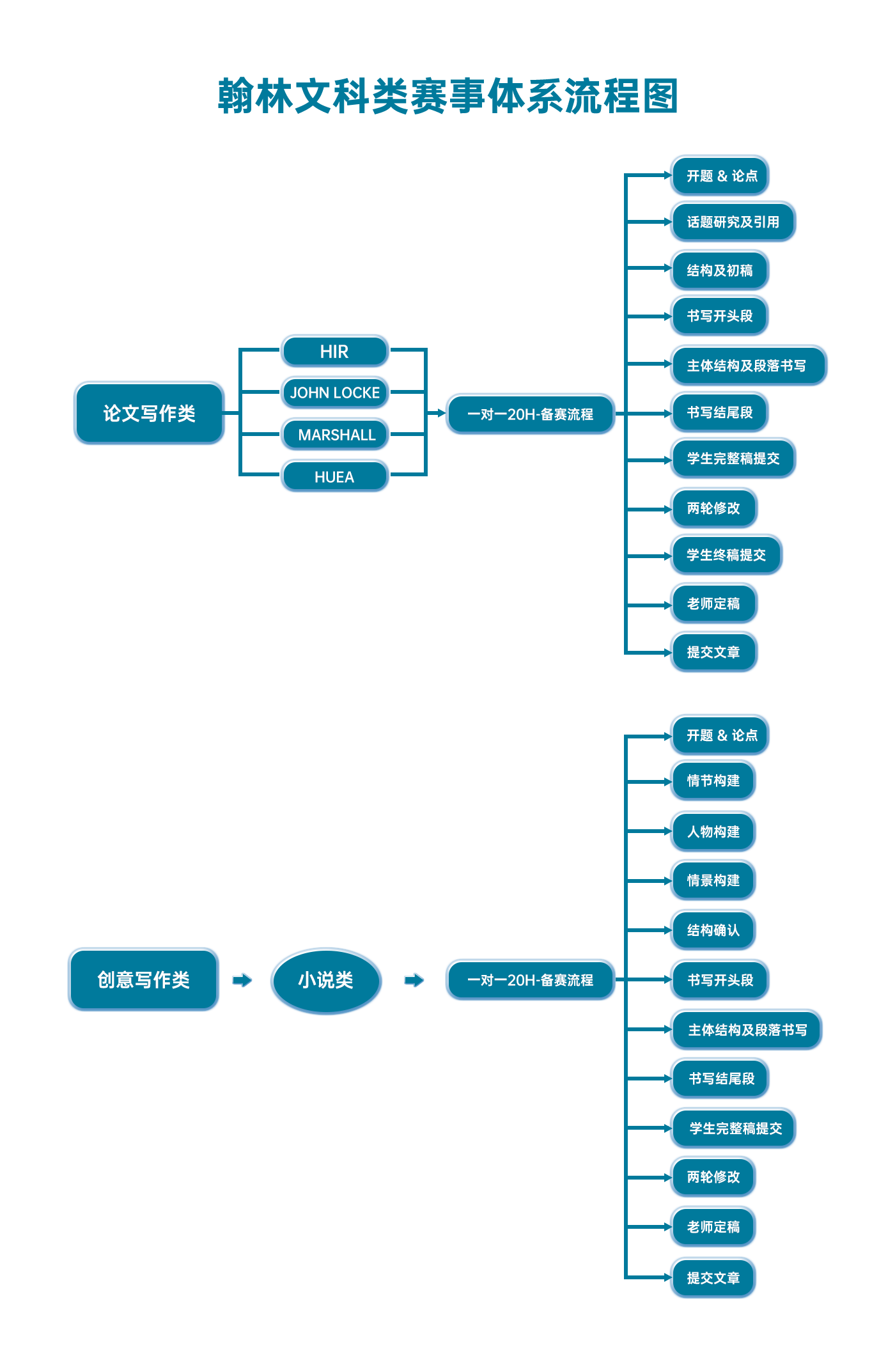
翰林文科學術活動課程體系流程圖
專業人,做專業事!
翰林文科學術活動課程體系流程圖

翰林AMC8視頻課重磅上線!

國際競賽真題資源免費領取







