【A-Level物理】重難點(diǎn)解析 | 簡(jiǎn)諧運(yùn)動(dòng)(上)

首先我們來(lái)看什么是波動(dòng)(oscillation):
Oscillation is a repeating back and forth movement on either side of an equilibrium position.
也就是說(shuō),是圍繞一個(gè)平衡位置的前后運(yùn)動(dòng),在我們蕩秋千時(shí),最低的點(diǎn),就是這個(gè)equilibrium position。
現(xiàn)在我們來(lái)看如何形容一個(gè)oscillation:
振幅(Amplitude):the maximum displacement from the equilibrium position.
周期(Period):the time taken for one complete oscillation.
頻率(frequency): the number of oscillations per unit time.
相位(phase): it describes the point that an oscillating mass has reached within the complete cycle of an oscillation.
相位差(phase difference):the degree by which one oscillation leads or lags behind another oscillation.
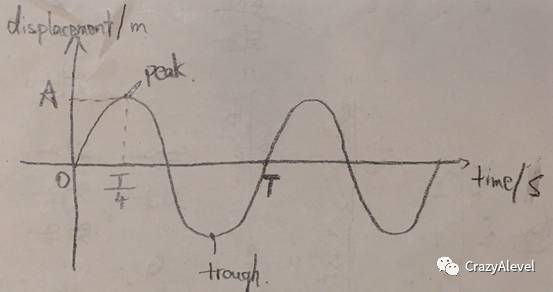
此圖為例,最高點(diǎn)叫peak,最低點(diǎn)叫trough,一個(gè)周期是一個(gè)完整的波動(dòng)所占用的時(shí)間(T);
peak到橫軸的距離,就是最大的displacement,叫做amplitude;
頻率等于周期分之一(f=1/T),單位為赫茲Hz,很多時(shí)候會(huì)用角速度ω(angular frequency),ω=2πf,單位為radians;
至于相位,我們把一個(gè)完整的周期當(dāng)成2π,那么比如圖中的peak的相位就是π/2.
相位差呢,是針對(duì)兩個(gè)或多個(gè)波動(dòng)來(lái)說(shuō)的,兩個(gè)信號(hào)上同樣的點(diǎn)(比如兩個(gè)peak)之間的相位差就是兩個(gè)信號(hào)的相位差。
描述完波動(dòng),我們來(lái)看簡(jiǎn)諧運(yùn)動(dòng)。
舉個(gè)例子:最經(jīng)典的,就是鐘擺,圍繞著中間的平衡位置一直波動(dòng),那么這種波動(dòng)和普通的波動(dòng)區(qū)別在哪,滿足哪些條件才能被稱為簡(jiǎn)諧運(yùn)動(dòng)呢?
1. A mass that oscillates
2. A position where the mass is in equilibrium
3. A restoring force that acts to return the mass to its equilibrium position (the force is directly proportional to displacement from equilibrium position and directed towards the equilibrium position or a fixed point)
以上是滿足簡(jiǎn)諧運(yùn)動(dòng)的條件,很容易考到,尤其是第三點(diǎn),在判斷是否是簡(jiǎn)諧運(yùn)動(dòng)的時(shí)候很重要,因?yàn)楹芏噙\(yùn)動(dòng)都可以滿足前兩個(gè)條件,所以一定要看使物體回到平衡位置的力是否是指向一個(gè)固定的點(diǎn)的,比如:
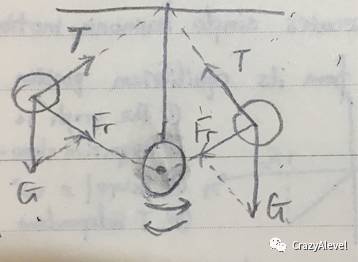
在這張圖中,運(yùn)動(dòng)的小球受到繩子的拉力T,重力G,在任何一個(gè)位置,受到的合力都是指向平衡位置的那個(gè)點(diǎn)的,所以這是個(gè)簡(jiǎn)諧運(yùn)動(dòng)。

翰林AMC8視頻課重磅上線!

國(guó)際競(jìng)賽真題資源免費(fèi)領(lǐng)取







