Edexcel IGCSE Biology: Double Science 復(fù)習(xí)筆記 2.4.2 Practical: Diffusion

Edexcel IGCSE Biology: Double Science 復(fù)習(xí)筆記 2.4.2 Practical: Diffusion
Practical: Factors that Influence Diffusion
- Diffusion is the?movement of molecules?from a region of?higher?concentration to a region of?lower?concentration
- The rate of diffusion is influenced by several factors:
- Temperature
- Surface area
- Concentration gradient
- Diffusion distance
- You can investigate how temperature affects diffusion using?beetroot
- Beetroot cells contain a?dark purple-red pigment
- Heating above 45℃?can damage the cell membrane meaning that the?pigment can leak out
- The speed at which this pigment leaks out of the cell tells us about the?rate of diffusion
Investigating the effect of temperature on diffusion
Apparatus
- Beetroot
- Knife
- Cork borer (optional)
- Cutting board
- Ruler
- Test tubes
- Water baths
- Stopwatch
Method
- Using a knife, cut 2?equally-sized?cubes of beetroot
- The pieces must have the same dimensions so that they all have?equal surface areas and volumes, as these factors could affect the rate at which the pigment leaks out
- A cork borer can also be used, as long as the cores are cut to the?same length
- Rinse?the beetroot pieces
- To?remove?any pigment released during cutting
- Put 5 cm3?of water into 2 test tubes labelled A and B
- Keep test tube A at?room temperature?and transfer test tube B to a?hot water bath at 90℃
- Leave the test tubes for 2 minutes, then add a piece of beetroot into each test tube
- After 10 minutes,?observe the colour of the liquid?in both test tubes
Results and Analysis
- You should notice that at the?higher temperature,?more of the pigment has leaked out?of the beetroot
- This is because:
- The cell membrane of the beetroot cells has become?damaged?so more pigment can leak out
- At higher temperatures, particles have more?kinetic energy, this results in the faster movement of particles compared to when they have less energy
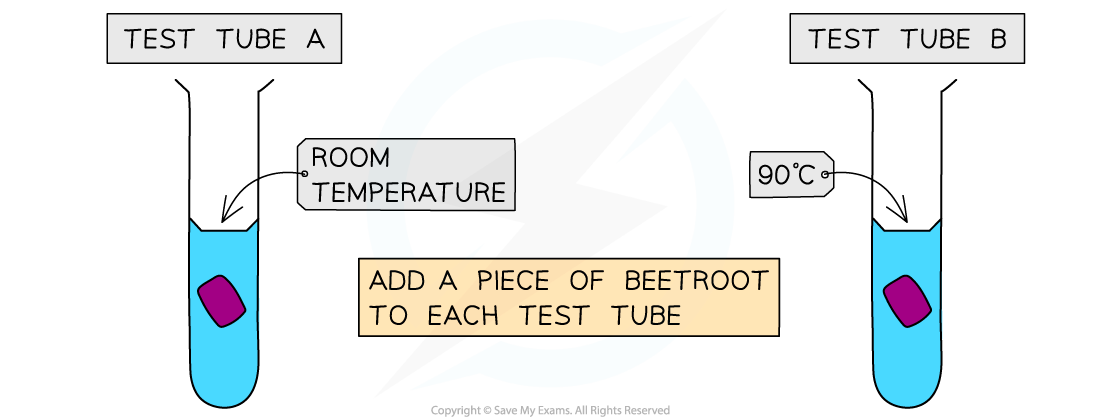
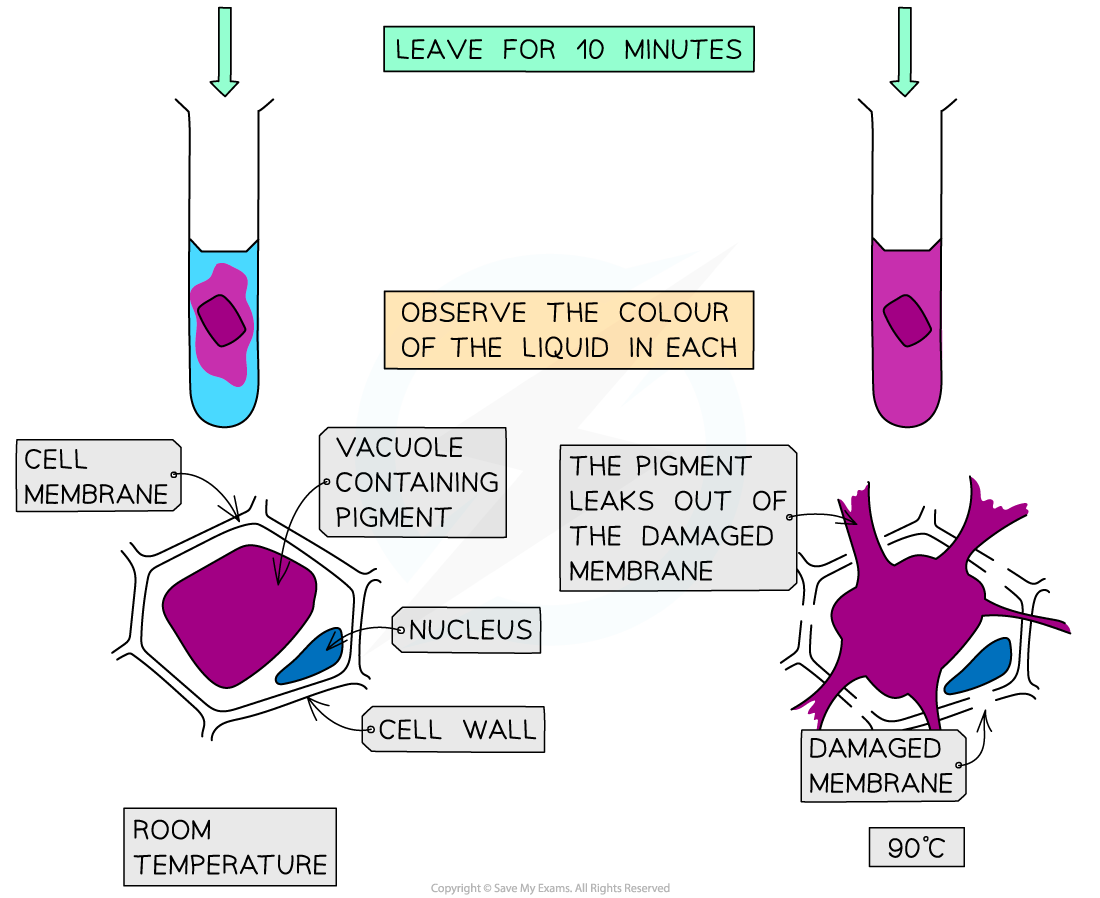
Investigating the effect of temperature on diffusion in beetroot
Limitations
- The beetroot pieces may not be identical in?size?and shape, meaning one test tube could contain slightly more beetroot tissue than the other
- Solution: cut the beetroot as?accurately?as possible using a?knife and ruler, and?repeat?each investigation several times to find a mean
- Some?parts?of beetroot tissue could have?more pigment?in their cells than others
- Solution: conduct several?repeats, using?different parts?of the beetroot and find a?mean
- Our results would be more reliable if we tested a range of temperatures rather than just testing 2
- Solution: Set up 5 test tubes in water baths at different temperatures (e.g. 10℃, 20℃, 30℃, 40℃, 50℃)
- Observing the colour is a subjective measure which means it is difficult to really compare the differences in diffusion between the test tubes
- Solution: use a?colorimeter?to measure how much?light?is?absorbed?as it passes through each of the five samples of coloured liquid
Applying CORMS to practical work
- When working with practical investigations, remember to consider your CORMS evaluation
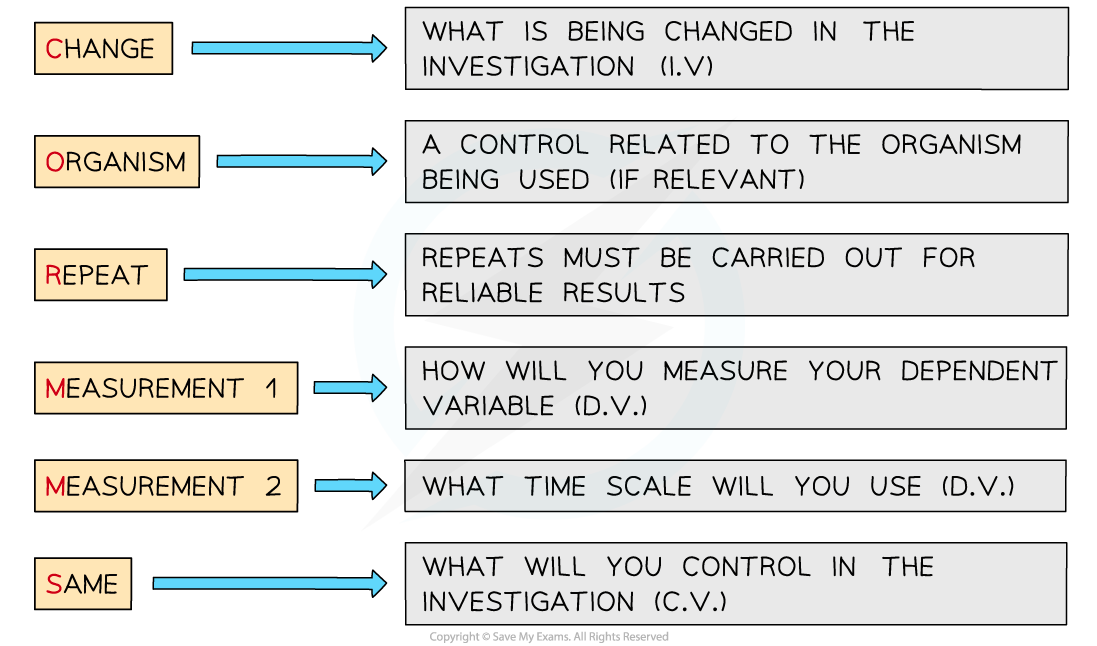
CORMS evaluation
- In this investigation, your evaluation should look something like this:
- C?- We are changing the temperature of the environment
- O?- The beetroot cubes will all be taken from the same beetroot or beetroot of the same age
- R?- We will repeat the investigation several times to ensure our results are reliable
- M1?- We will observe the colour change of the liquid
- M2?- ...after 10 minutes
- S?- We will control the volume of water used, the dimensions of the beetroot cubes and each cube must be blotted before it is weighed each time
轉(zhuǎn)載自savemyexams

翰林AMC8視頻課重磅上線!

國(guó)際競(jìng)賽真題資源免費(fèi)領(lǐng)取







